DigitalSurge voluntary administration Australian class ruling
Last updated: October 15, 2026
How to Apply the Rules Outlined in the ATO Class Ruling CR 2024/50 for DigitalSurge voluntary administration
What is the ATO Class Ruling CR 2024/50?
The ATO Class Ruling CR 2024/50 is a ruling issued by the Australian Taxation Office (ATO) regarding the voluntary administration of Digital Surge Pty Ltd. This ruling outlines the specific rules and regulations that apply to this particular situation.
Why is it Important to Follow this Class Ruling?
It is important to follow this class ruling because it provides guidance on how to handle the tax implications of Digital Surge Pty Ltd's voluntary administration. By following this ruling, you can ensure that you are complying with all relevant tax laws and regulations.
How to Apply the Rules Outlined in the Class Ruling
Summ (formerly Crypto Tax Calculator) have worked with Digital Surge to offer an easy solution for managing your tax liabilities from this class ruling.
In this guide I will be referring to the class ruling as interpreted by Cadena Legal that can be found attached to the bottom of this article.
To apply the rules outlined in the class ruling, follow these steps:
Import your DigitalSurge data via our direct API integration
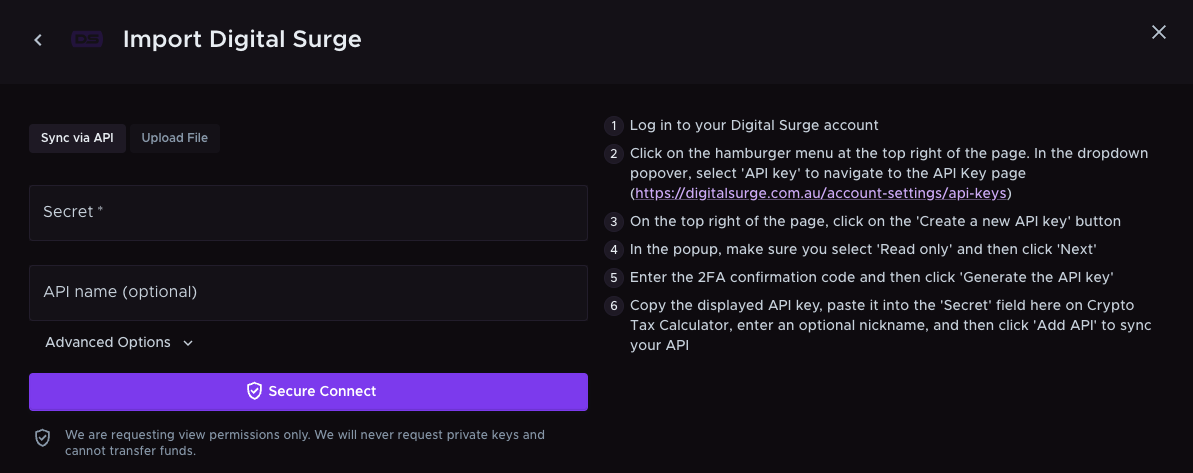
Summ will then pull in all the relevant information relating to the three (3) key taxing points mentioned in the class ruling under table 1 - Taxing Points for Customers.
Event A - Termination of the DOCA.
This is basically the event where creditors forfeited their CGT assets for a claim against the Creditors' Trust and would thus be imported as a CGT event. This can be seen in the below image as a trade of the forfeited assets to a token called "Creditor's Trust Claim":

Event B - Repayment of Eligible Priority Customer Creditors.
This is only for customers who had held an account balance equal to or less than $250, you would have been fully repaid your account balance on 17 February 2023.
Under the Ruling, this means that:
On 17 February 2023, you received a payment that fully satisfied your
claim against the Creditors’ Trust.
The customer will need to declare that the CGT event occurred, but because Event A and Event B happened in the same
income year, there should be no net capital gain or loss.
Summ will import this CGT event/s as as a trade of the "Creditor's Trust Claim" asset we received in Event A into the assets that were received back from Digital Surge on the 17th of February 2023, as can be seen in the below image:

Event C - Partial or Full Repayment of Eligible Customer Creditors.
This is only for customers who held an account balance above $250, you would have been paid 57% of your account balance on 17 February 2023. You may receive further repayments to satisfy your claim against the Creditors’ Trust over time. Under the Ruling, this means that:
On 17 February 2023, you received a payment that satisfied 57% of your
claim against the Creditors’ Trust. This triggers a CGT event with respect to 57% of your claim against the Creditors’ Trust.You may receive further repayments over time which will be imported and calculated into Summ when you re-sync your Digital Surge integration.
Summ will import these CGT events as:
A trade or trades of 57% of the "Creditor's Trust Claim" asset we received in Event A into the assets that was received back from Digital Surge on the 17th of February 2023, as can be seen in the below image:
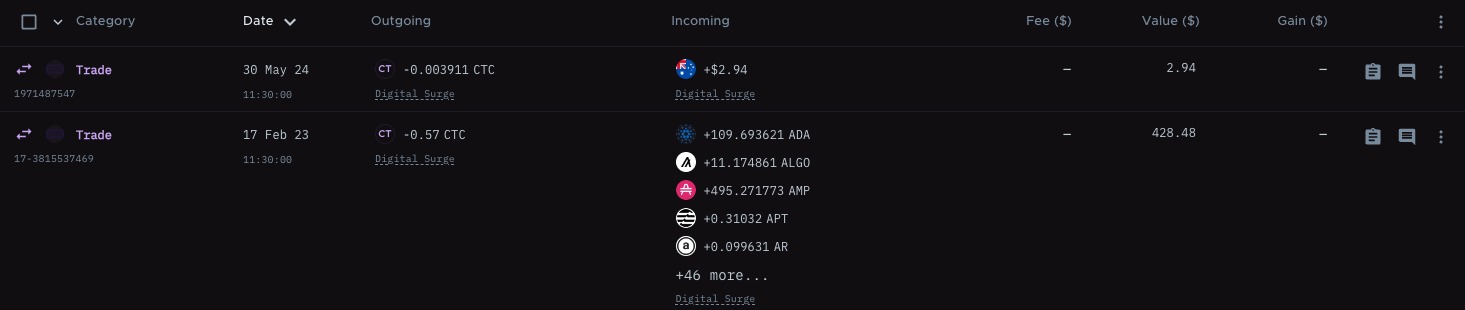
If future reimbursements occur, you will need to re-sync your Digital Surge integration from step 1 to ensure that the updated data is accurately reflected.
Lastly as stated in Table - 2 of the class ruling, the ATO has not provided a methodology to determine the “market value” of the claim against Digital Surge nor the claim against the Creditors’ Trust.
From a practical perspective, Customers may consider using any of the following three (3) options to determine the market value of both claims as at 15 February 2023:
Account Method
You use the value attributed to your account as at 8 December 2022.
Discount Method
You apply a percentage ranging from 45% to 69% to the value attributed to
your account balance as of 8 December 2022, which reflects the estimated rate of return for customers.
Independent method
You obtain an independent valuation which determines the AUD value
of your claim against Digital Surge and your claim against the Creditors’ Trust as at 15 February 2023.
By default Summ will be using option A (Account Method) but if you choose to use either option B (Discount method) or option C (Independent Method) then you can follow the below instructions:
Navigate to the Transactions page and add a filter for "Tx Currency: Creditor's Trust Claim" as seen in the below image:
Locate the trade on the 15th February 2023 and click on the incoming "Creditor's Trust Claim" token as can be seen in the below image:

Enter the value that you have calculated based on either the Discounted Method or the independent valuation you have received. These values should be applied to the Value (AUD)* column on the "Buy" side of the trade. As can be seen in the below image:

By following these steps, you can ensure that you are properly applying the rules outlined in the class ruling and avoiding any potential issues with the ATO.
When to Seek Professional Tax Advice
If you are unsure about any aspect of the class ruling or how it applies to your situation, it is always best to seek professional tax advice. A qualified tax advisor can provide you with personalised guidance and ensure that you are complying with all relevant laws and regulations.
It is especially important to seek professional tax advice if you are dealing with a complex or unique situation, as the class ruling may not cover all possible scenarios.